

Your physical yoga practice can continue once you step off the mat. During the day, there are often plenty of opportunities to get some extra stretching and breathwork in. Consider these six ways for how to do yoga in everyday life and make yoga part of your whole-day routine.
1. Face Yoga While Relaxing
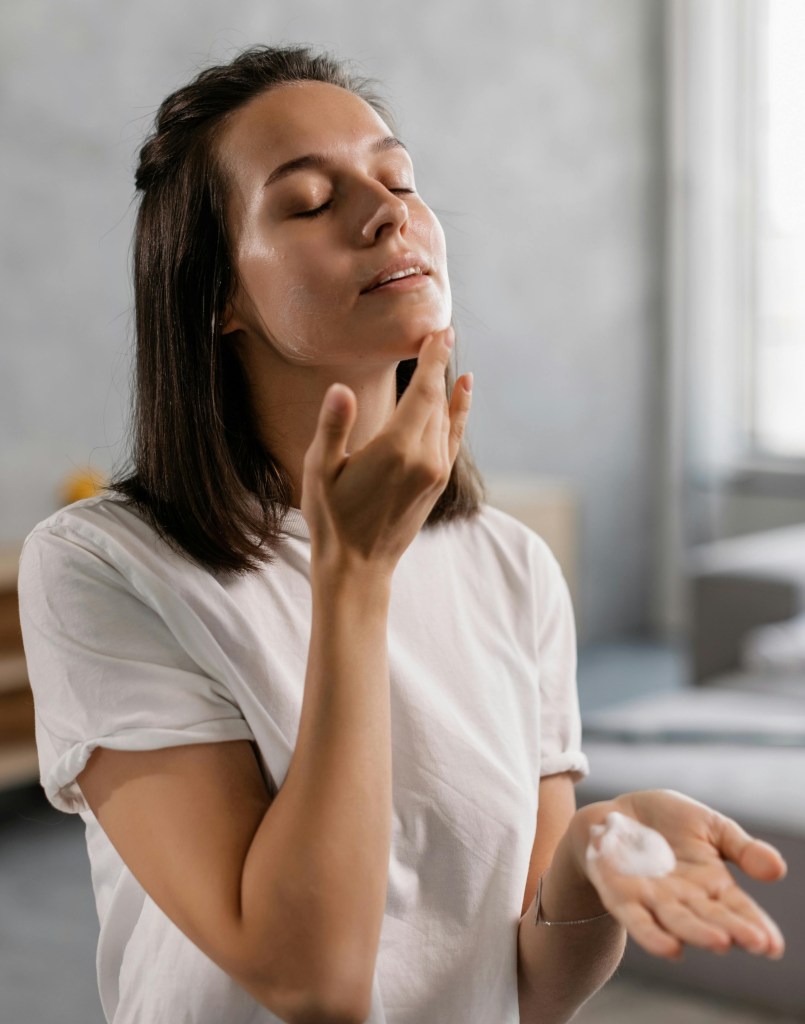
Did you know, the face has more than 40 muscles? Just like the Centers for Disease Control and Prevention recommends we do at least 2 days of strength training exercises for our body’s muscles each week, we can also work the muscles in our face. Doing so can even have anti-aging effects.
Some of my favorite face yoga practices I like to do, especially in a passive activity like watching TV, include:
- Making the mouth open into an O-like shape and then going into a smaller circle, repeating for about a minute
- Tapping and massaging the face (forehead, cheeks and chin) and neck, to boost circulation and promote collagen production, for about a minute
- Smiling wide then relaxing, and repeating this quickly for about a minute
- To stretch the neck and jaw, tilting the head back, jutting the bottom lip out, and holding for about a minute
You can also incorporate face yoga into your morning or nighttime skincare routine, as practices like massage and tapping can help with skincare product absorption. For more face yoga exercises, my favorite teacher is Danielle Collins – you can watch her videos here.
2. Tadasana While Standing

Tadasana (Mountain Pose) may seem like a simple yoga pose, but it can be quite challenging, as many of us struggle with poor posture. That can lead to major problems down the road, as Consumer Reports states up to 40% of people older than age 60 and 55% of people older than age 70 aren’t able to straighten up.
You can practice Tadasana anywhere you’re standing, such as while waiting in line. Focus on:
- Keeping your feet hip-width distance apart and balancing evenly into both your feet
- Relaxing your shoulders away from the ears
- Drawing your chin slightly in to align your head with your torso
I like to imagine a string is pulling the crown of my head straight up to the sky, which helps elevate the head.
Proper posture, achieved with the help of practicing Tadasana, can help you project confidence, according to Psychology Today. You can also use Tadasana to visualize energy flowing from the earth up through you, radiating out positively as you go through your day.
3. Neck Stretches While Sitting/Standing
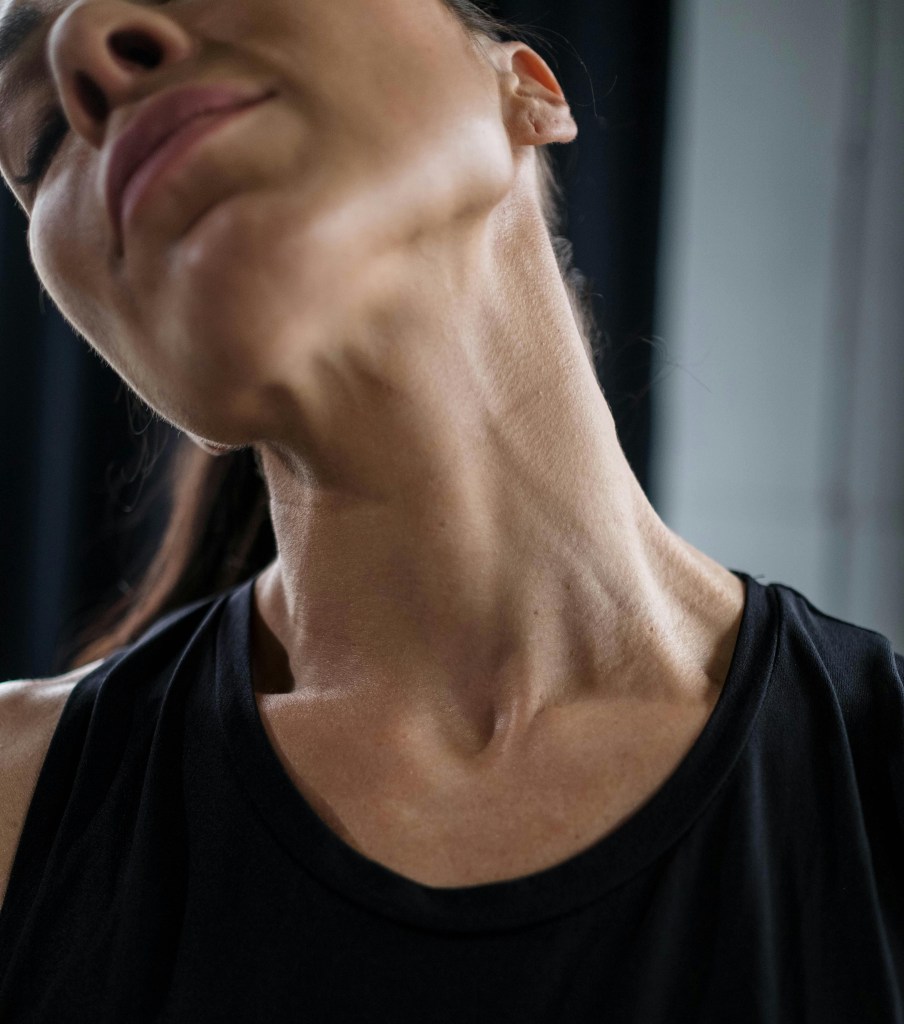
We often do neck stretches during our yoga warm-ups, and you can repeat these while you work at a desk throughout the day or wherever you are. Take frequent breaks to stretch out your neck, since doing so can decrease neck pain, improve neck function, and boost quality of life.
Here are some neck stretch ideas (and remember: always consult a physician before you start a yoga practice):
- Sitting up tall, place your palms in your lap if your sitting, or down by your sides if you’re standing. Release your right ear to your right shoulder. Draw the left shoulder down. Hold for at least three deep breathes. Switch sides, and repeat.
- Sweep your chin from side to side over your collarbone, linking your breath with your movement to inhale one direction, and exhale the other.
- If it’s OK for your neck and you’re not pushing yourself toward pain, do full neck circles for around 30 seconds one direction. Pause, switch directions, and repeat.
Even doing something simple as looking right to left and up and down can help stretch out your neck. Try to take inventory of how your neck feels throughout your day to become more in tune with your body.
4. Shoulder Stretches While Standing/Sitting

When I have more room and am standing somewhere, I love to sneak in some shoulder stretching. Cooking or baking are great times to get some extra shoulder stretching in, while you’re waiting for your oven to warm up or in-between chopping and measuring ingredients.
My favorite shoulder stretch is to interlace fingers behind the back, stand up tall, then lead with the chin and chest to lower my upper body down. I’m flexible enough where my arms can go straight and my knuckles go toward the sky. I move the knuckles right to left to stretch out my shoulders. If you’re in the position, you can bend your knees as much as you’d like, and even reach your torso to your thighs.
You can also interlace your fingers while standing still and not bending over, if you’re in public. At your desk or sitting somewhere like a waiting room or on the metro, you can interlace your fingers behind your head, push the head into the hands, and open up the elbows, to feel a nice shoulder and upper back stretch.
5. Yoga in Bed

If you’re reading, watching TV or meditating in bed, you can also use that as an opportunity to practice more yoga. Some poses to consider, which you can read more about how to do here, include:
- Supine Butterfly (Supta Baddha Konasana)
- Supine Spinal Twist (Supta Matsyendrasana)
- Knee-to-Chest (Apanasana)
- Legs Up the Wall (Viparita Karani)
- Savasana (Corpse Pose)
You can do yoga in bed to start your day or to end it. Even in a passive environment, you can still get some extra stretching in with these bedtime yoga poses.
6. Deep Breathing Anywhere, Anytime

The most important part of a yoga practice is the breath. It allows you to settle into poses, to find the balance between effort and ease in a flow, and to connect your mind and body awareness. Focusing on your breath outside of your mat can have countless benefits, reports the American Heart Association, including:
- Lower stress
- Pain management
- Reduced symptoms of depression and anxiety
- Stabilized blood pressure
- Increased sense of calm
- Improved oxygen delivery
You can practice yoga anytime, anywhere, by focusing on your breathing. In yoga, breath control is known as “pranayama”. Pranayama is mindful breathing, where you’re conscious of the timing of both inhales and exhales.
You can experiment with different types of yogic breathing exercises, but simply taking deep inhales and deep exhales for a few minutes at a time can increase focus and decrease stress. Integrate this everyday yoga practice into your daily life to observe the effects.
How Do You Do Yoga in Everyday Life?
The above are just a few ideas for incorporating a physical yoga practice into your everyday life. Simply being conscious of your posture, your breath and your body can help you improve your flexibility, range of motion and awareness.
Next time you’re bored, think about something from yoga you could do that might help enhance that moment. You may notice your whole day becomes more positive, far beyond your time on the mat.
How do you incorporate yoga throughout your day? Share your ideas in the comments.
Have a yoga topic you’d like me to write about on the blog? Message me.

Leave a Reply