
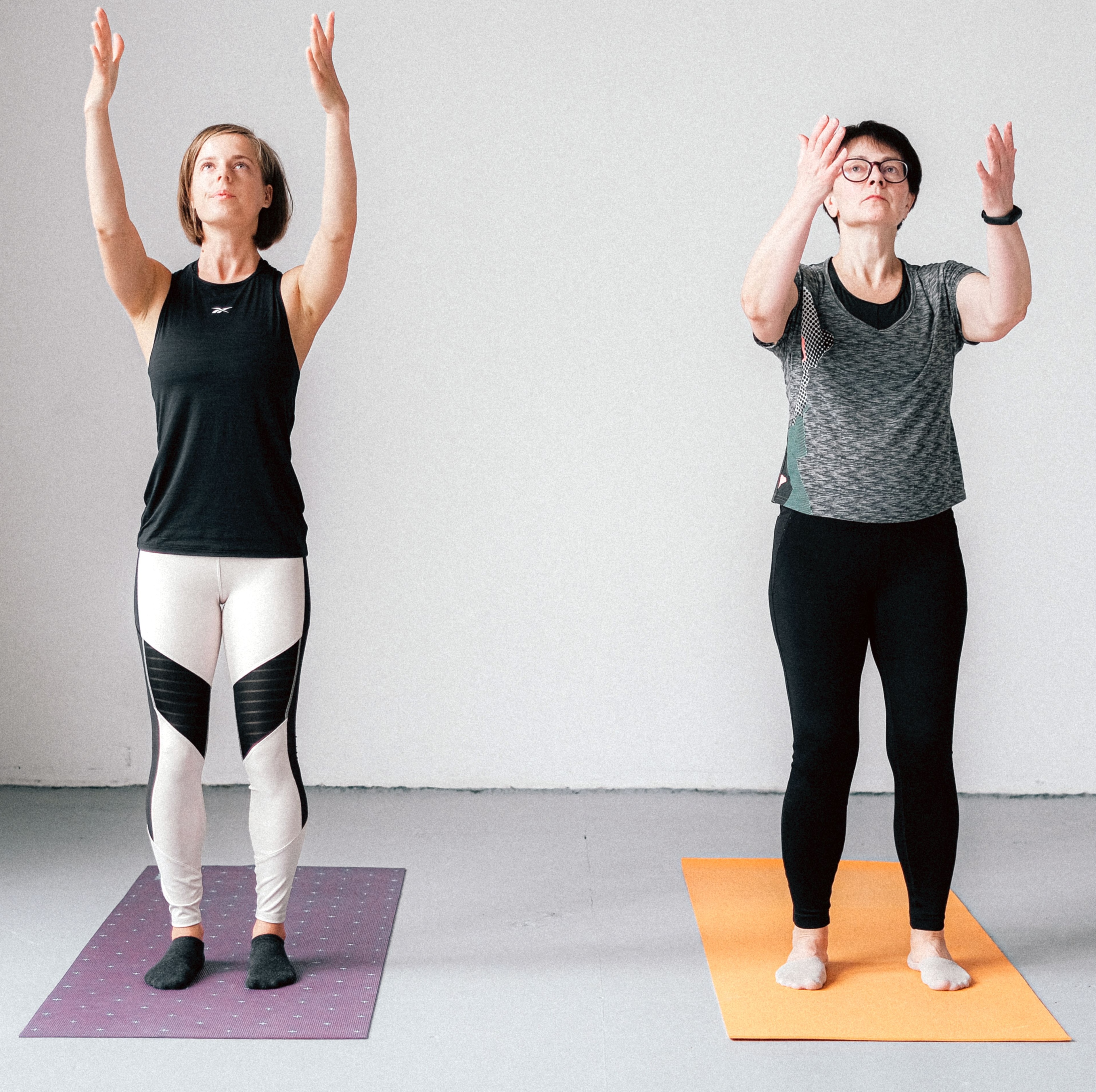
One of the most energizing ways to start a yoga practice is to use the Breath of Joy to get moving and start being more mindful of how you use the breath in yoga. The Breath of Joy is an invigorating breathing practice that involves moving your arms and standing while doing it. It can get your heart pumping and blood flowing, setting you up to tackle the rest of your practice.
I particularly like to teach Breath of Joy when the room my class is practicing in is particularly cold, since it’s a good way to warm up right at the beginning of a practice. Most of my classes begin in Sukhasana (Easy Pose) or lying down, so Breath of Joy also adds some variety for students who are used to starting a yoga class from a more passive or relaxed position.
Learn more about how to do Breath of Joy, what the benefits of Breath of Joy are and how Breath of Joy can invigorate your yoga practice for the day.
How to Do Breath of Joy

Breath of Joy is a three-part inhalation through the nose, with a forceful exhalation through the mouth. Each breath is accompanied by arm and body movements, making Breath of Joy a full-body breathing exercise. To do Breath of Joy:
- Begin standing in Mountain Pose (Tadasana).
- Inhale through the nose one-third of the way to your lung capacity, while raising the arms to shoulder height, with the palms facing each other.
- Inhale through the nose two-thirds of the way to your lung capacity, while extending the arms out to the sides to shoulder height, with the palms facing forward.
- Inhale through the nose the rest of the way to your lung capacity, raising the arms overhead, with the palms facing each other.
- Sweep the arms down, and exhale with a sigh through the mouth, folding completely and bending the knees as much as you need to.
- Repeat up to 10 times.
- After the last breath in the sequence, take a few moments in a folding fold.
- Repeat the sequence again.
As you can see from the sequence, Breath of Joy primes you to link your breath with movement. Your inhales should be short and sharp, and your exhale can be as deep and forceful as you’d like. Once you do your last exhale in the sequence, you may feel alert and energized, while also letting go of what no longer serves you, feeling primed to do your yoga practice.
Benefits of Breath of Joy in Yoga

According to Harvard Health Publishing and Yoga International, some of the benefits of Breath of Joy include:
- Increases oxygen levels in the bloodstream, sending more oxygen to the body and brain
- Temporarily stimulates the sympathetic nervous system
- Calms the mind and increases focus
- Releases pent-up tension
- Detoxifies the body
- Increases physical and mental energy levels
At one studio I took classes at, we used to start every single class with Breath of Joy. I felt like the practice helped ease me into the class, as it was a simple way to introduce gentle movement and focused breathing into my practice, that seamless transitioned to more progressive poses.
You can use Breath of Joy at the beginning of a class, to literally warm students up, like I’ve done many times. It can also be used in the middle of a class to break apart other sequences, or at the end of class to close a practice, tie everything together, and leave students with a sense of energy before they settle into Savasana or go about their day.
Precaution: Yoga International cautions those with high blood pressure, head injuries, eye injuries, migraines and/or glaucoma to avoid doing Breath of Joy. If you start to feel light-headed, stop the practice, and breathe normally.
What Are Your Thoughts on Breath of Joy?
Have you done Breath of Joy in your yoga practice? Do you enjoy it? Are there any tips you’d share for mastering the breathing technique in this practice?
Share your thoughts in the comments! Do you have a different favorite breathing technique in yoga? Please let me know.
If there’s a topic you’d like me to write about on this yoga in Alexandria blog, contact me.


Leave a Reply