
I’ve recently worked with several yoga students in Alexandria VA yoga classes who have sciatica and come to yoga for ways to stretch and relieve nerve pain. This shouldn’t be surprising, as sciatica is fairly common. According to Harvard Health Publishing, up to 40% of people will experience sciatica during their lives. The risk of sciatica increases with age.
If you’ve experienced sciatica and want to integrate yoga as a form of helpful exercise, the following are some things to keep in mind and poses to try on your journey.
Remember: always talk with your physician before beginning any type of exercise regimen. If you have sciatica, consult with your physician about what yoga poses are safe for you, and things to avoid in your practice.
What Is Sciatica?

We have something called a sciatic nerve, which is the longest, thickest nerve in the body that runs down from your lower back, through your glutes and each leg. When the sciatic nerve, which is actually made up of a bundle of nerves, experiences pressure, you might feel pain, inflammation, pinching, compression or even numbness in the affected leg, lower back, hips and/or glutes.
According to Cleveland Clinic, most people with sciatica can heal through self-care, including with practices such as yoga. Some people with sciatica may require surgery.
Consult your physician for treatment options and recommendations for sciatica.
What Causes Sciatica?
According to Cleveland Clinic, sciatica rarely happens before the age of 20, unless it’s related to an injury. Anything that affects the sciatic nerve can cause sciatica symptoms, including:
- Pregnancy
- Injuries, especially those to the spine and/or lower back
- Herniated disks
- Osteoarthritis
Other conditions, such as excess weight, obesity, improper posture and insufficient core strength, can also contribute to sciatica risk. That’s why yoga may be recommended as an exercise for those with sciatica, as you can learn postures to help strengthen your core and relive tension from the lower back. A yoga practice can also aid weight loss and improve posture.
For sciatica self-care treatment, hot and cold treatments, as well as nonsteroidal anti-inflammatory drugs (NSAIDs), may also be recommended.
Talk with your doctor about sciatic pain relief recommendations.
Yoga Poses for Sciatic Pain Relief
For those with sciatica, there are several yoga poses that can help with sciatic nerve pain relief. The following help stretch the muscles surrounding the sciatic nerve, targeting areas including the lower back, glutes and hamstring muscles.
Sphinx Pose (Salamba Bhujangasana)
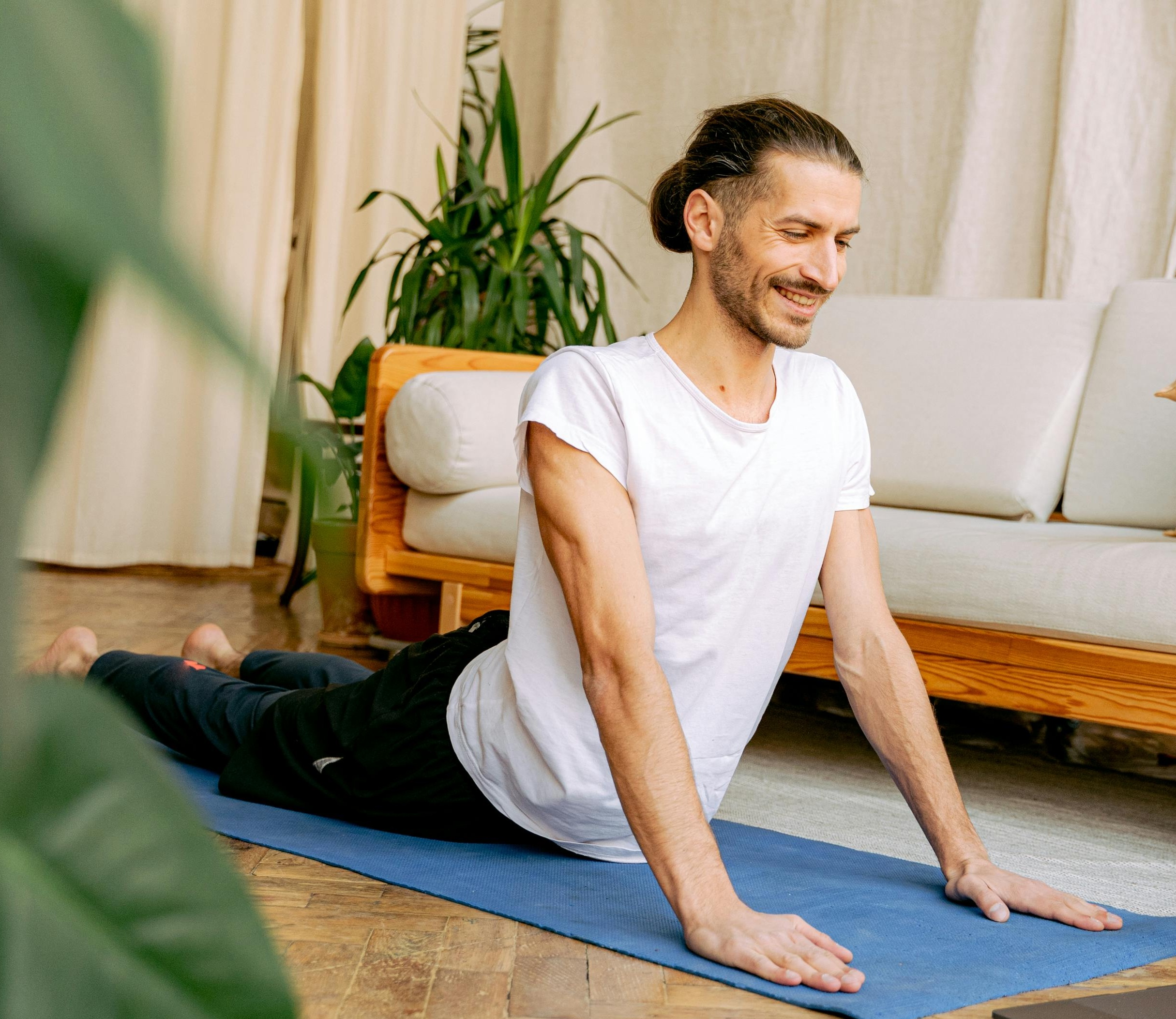
Sphinx Pose (Salamba Bhujangasana) is a supported backbend that translates to “supported cobra pose” in Sanskrit. Before progressing to Cobra Pose (Bhujangasana), you can use Sphinx to stimulate the abdominal area and gently stretch the lower back with support.
- Come onto your stomach, with your legs stretched hip-width distance behind you and the tops of your feet pressing into the mat.
- Position your arms like a number 11, with the elbows directly under your shoulders.
- Take deep breaths.
Relax your shoulders in this pose. You can squeeze your glutes and engage your quads to deepen the stretch.
Cobra Pose (Bhujangasana)
Progress Sphinx Pose to Cobra Pose. Release your chest and head to your mat. Place your hands under your shoulders. Push your hands into the mat, as you lift your chest and look forward. Hug your elbows into your ribs.
Again, relax your shoulders in the pose. Engage the legs as you press the tops of the feet into the mat. Breathe.
Knees-to-Chest Pose (Apanasana)
Lying on your back, bring both your knees into your chest, and place your hands on or wrap your arms around your shins for a nice lower back massage. Rock from side to side, keeping your head on the ground or bringing your nose to your knees, depending on your neck strength and comfort.
From there, you can place your hands on your knees and draw them out away from each other in circles and back in toward each other. Reverse the direction of the circles, and repeat.
For a single leg Knee-to-Chest Pose, extend the left leg long, and hug your right knee in toward your inner right arm. Rotate the foot around for some ankle circles. Flex your left toes toward your face to keep that leg active. Switch sides.
Lying Down Figure 4 Stretch

Pigeon Pose (Eka Pada Rajakapotasana) can help those with sciatica, but for beginner yogis, Lying Down Figure 4 Stretch offers a more supported pose. You can transition from a single leg Knee-to-Chest Pose to a Lying Down Figure 4 Stretch, then repeat on the other side.
- Hugging your right knee into your chest in Knee-to-Chest Pose, lift your left leg straight up.
- Cross your right ankle over the left thigh.
- Weave your right arm through the middle window you’ve created.
- Interlace your fingers behind the left thigh or on top of the left shin.
You can rock from side to side if that feels good, and use the right elbow to open up that thigh a bit more. Repeat on the other side.
Bridge Pose (Setu Bandha Sarvangasana)
Bridge Pose (Setu Bandha Sarvangasana) strengthens the core, lower back and glutes, making it a great pose to target areas that might experience sciatic nerve pain.
- Lie down on your back.
- Bend your knees, and bring the soles of the feet on the floor.
- Reach your fingertips toward your feet, keeping the feet and knees around hip-width distance apart.
- Press your feet and hands into the mat, to lift your hips up.
- Squeeze your glutes, and engage your core.
You can make the Bridge Pose more supported by sliding a block under your sacrum. For a more active Bridge Pose, interlace your fingers underneath you, and roll your shoulders under to help lift your hips up higher.
Other Yoga Poses for Sciatica

Because each person’s sciatica symptoms (and bodies) are different, there aren’t specific yoga poses to avoid altogether for sciatica. However, it’s mindful to ease yourself slowly into any pose so you don’t push yourself to the point of pain in yoga. Some people find poses like Pyramid (Parsvottanasana) and Forward Fold (Uttanasana) are helpful for sciatica, because they stretch the hamstrings. But going too deeply too quickly can exacerbate lower back pain. For poses like these for those who have sciatica, using yoga props like blocks to lift the floor up to you can be very helpful.
For poses to help with lower back pain and stretching and strengthening the core, glutes and hamstrings, consider integrating the following into your practice.
- Child’s Pose (Balasana)
- Cat-Cow (Marjarysana-Bitilasana)
- Downward-Facing Dog (Adho Mukha Svanasana)
- Locust Pose (Salabhasana)
- Legs Up the Wall Pose (Viparita Karani)
- Half Moon Pose (Ardha Chandrasana)
It’s essential when doing any yoga pose to listen to your body, go slowly, and back off if you feel pain. Using props like blocks and blankets can be helpful, especially for those with sciatica, as they help make it easier to reach the floor and provide extra support where needed.
Yoga Can Help Improve Your Health

There are many physical benefits of yoga, especially for those with sciatica. A yoga practice can help those with sciatica:
- Build strength in the core, low back, glutes and hamstrings
- Stretch muscles that surround the sciatic nerve
- Achieve a healthy body weight
- Relieve stress and tension that may contribute to sciatic nerve pain
As always, consult your physician before starting a yoga practice.
Have you helped relieve sciatic nerve pain due to your yoga practice? Share your experience in the comments.
Is there a yoga topic you’d like me to write about next on this yoga in Alexandria blog? Send me a message.
About the author: Nicki Escudero is a journalist and RYT-200 yoga instructor certified by Yoga Alliance. She teaches group and private yoga classes in Alexandria, VA, and Washington, DC. Contact Nicki.



Leave a Reply