
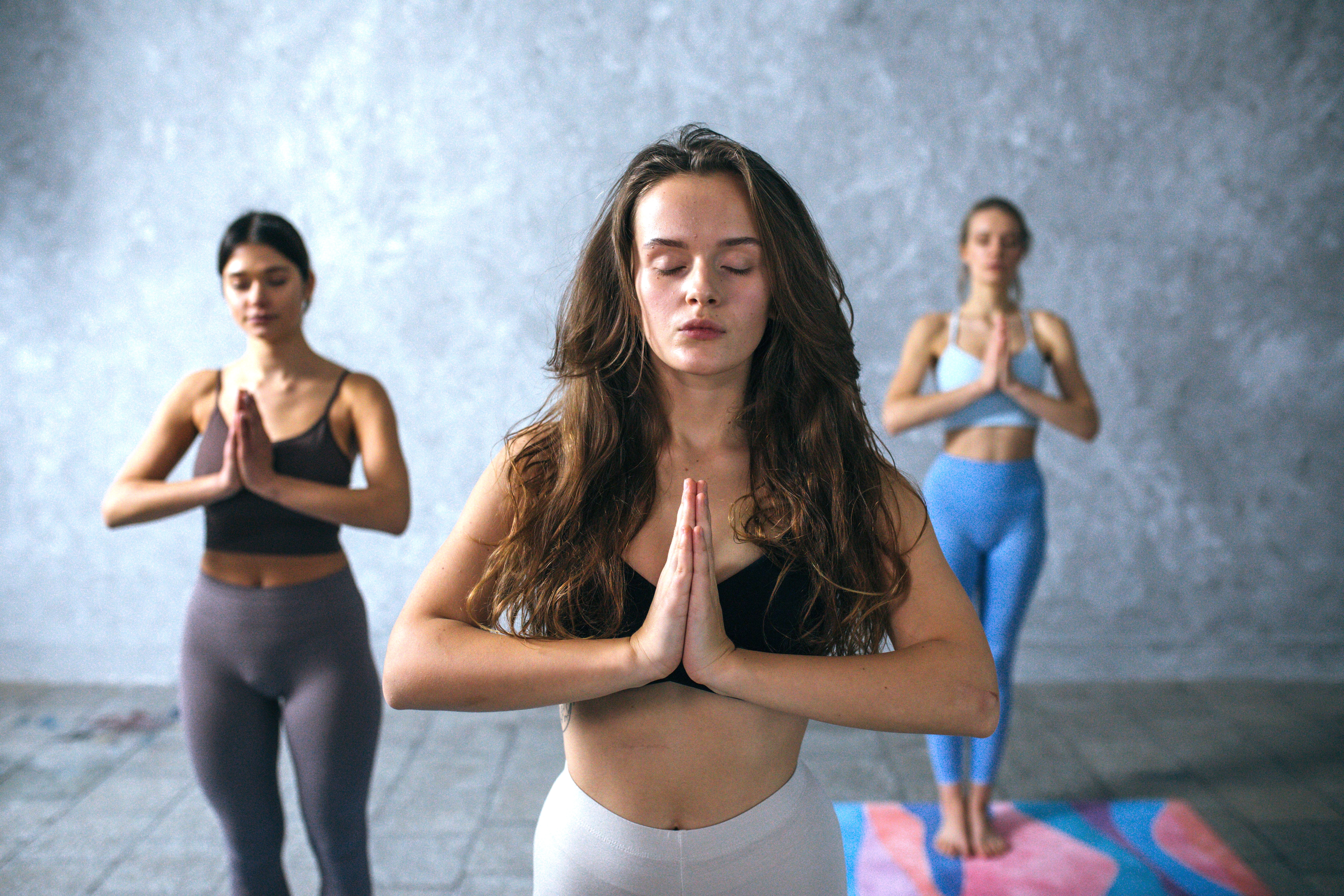
The Anjali Mudra, also known as the Namaskar Mudra, is one of the most common hand positions we’ll use in all types of yoga classes, especially yoga where meditation or meditative motion is a strong focus. Also known as “prayer hands” or cued as “bringing your hands into prayer,” you don’t have to be religious at all to gain the benefits of this powerful movement.
Learn more about how to use this meaningful hand and finger gesture in your practice, plus benefits you get from doing so.
Want to learn more about mudras? Learn about the Jnana Mudra here.
What Is the Anjali Mudra?

In yoga, whenever you hear the term “mudra”, you’re hearing what’s described as a sacred gesture that means to “seal”. A mudra harnesses distinct energy for that particular position.
As a study on the effect of yoga mudras in improving health shows, we have elements of our fingers and hands that are also associated with various disorders and disease. Research shows practicing mudras can help alleviate tension and enhance brain activity, as well as provide physical benefits like improved blood circulation and better sleep.
There are different mudras to try in your yoga practice. For example, the Jnana Mudra is often used during meditation or warm-up/cool-down portions of a yoga class. Another meditative mudra is the Dhyana Mudra, often associated with Buddha statues, where the figure cups the hands palms up and rests them in their lap, with the thumbs connecting to each other.
The most common mudra I use in Alexandria yoga classes I teach is the Anjali Mudra, sometimes also known as prayer hands or the Namaskar Mudra. Anjali means “to offer” or “to salute”.
The Anjali Mudra is a form of reverence. For people who are actually praying, they’re revering whoever they’re praying to. In yoga, prayer hands serve as a symbol of revering the practice and offering space to those around you. I also like to think it’s a way to show respect and gratitude to yourself for showing up to your mat to practice.
How to Do Anjali Mudra
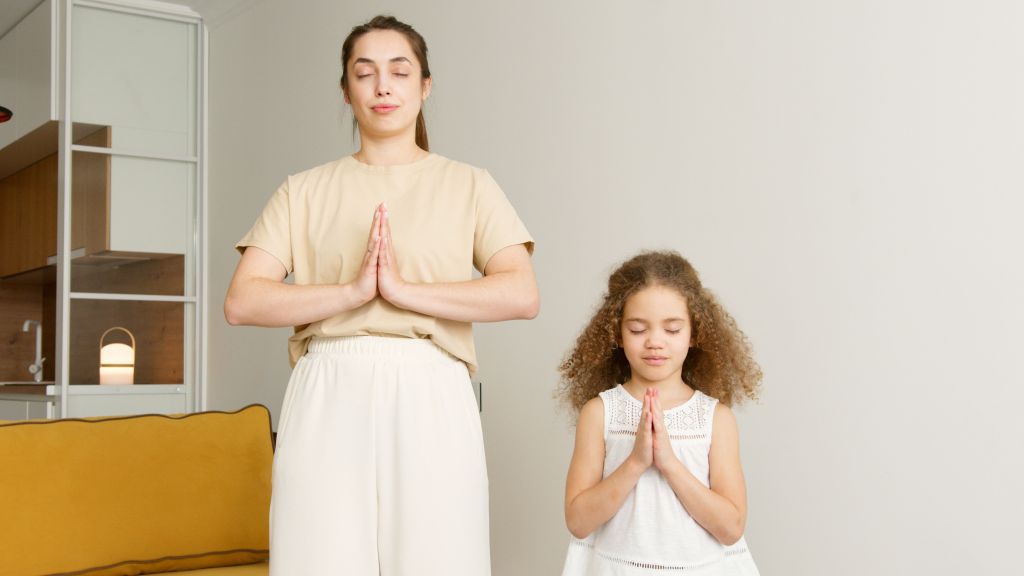
To do the Anjali Mudra, you bring both your palms together, with the fingers pointed upward toward the sky, and the heels of the hands touching.
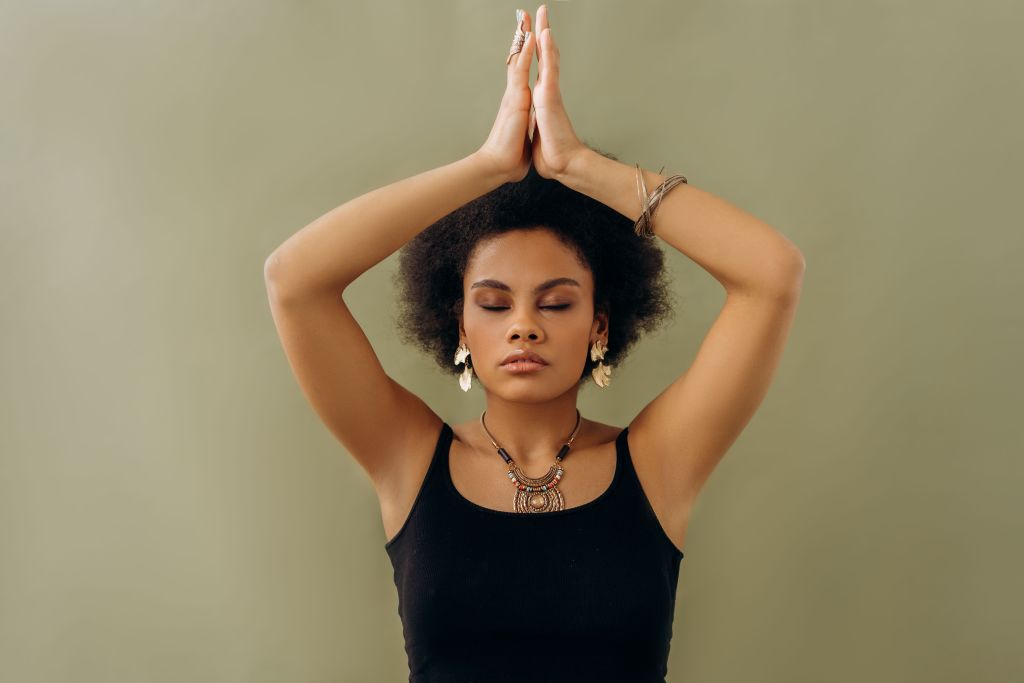
Typically, you’ll bring prayer hands into the center of your chest, drawing the thumbs toward your sternum, which is the bone connecting each side of your rib cage. You can also do prayer hands in many other variations, from reaching them overhead, to bringing the thumbs to the third eye center to close out a practice.
Some ideas for how to incorporate Anjali Mudra into an Alexandria, VA yoga practice or beyond include:
- In Sukhasana (Easy Seat), start a practice by bringing your hands into prayer to center and ground yourself for your yoga practice.
- In standing poses like Mountain Pose (Tadasana) and Warrior I (Virabhadrasana I), use the Anjali Mudra to add variety to your poses, even reaching the arms overhead with the hands in prayer.
- In yoga balancing poses, like Tree Pose (Vrksasana), Warrior III (Virabhadrasana III), Twisted Lunge (Parivrtta Anjaneysasana) and Standing Figure Four Pose (Ardha Utkatasana), bring your hands into prayer to center yourself.
You can also use Anjali Mudra to seal your practice and offer gratitude for yourself and those you shared the space with to close a yoga practice. Experiment with integrating prayer hands in your practice, and see what resonates with you.
Do You Enjoy Anjali Mudra?
One hang-up I could see with yoga students using Anjali Mudra is that it may seem too “prayer”-like for those who are anti-religion. I can’t speak for all atheists or for people who have experienced trauma due to religion, but I could imaging that asking a student to bring their hands into prayer may be triggering for some people. It’s something I’m aware of as a teacher.
If your yoga teacher cues you to bring your hands into prayer, but you’re not comfortable with doing so, remember that your practice is your own. You never have to do something that makes you feel uncomfortable. Skip the cue if that works best for you.
For me personally, I was raised in a Catholic school environment from preschool through high school, where we’d have mass up to several times a week. I identify as agnostic now. While the prayer hands do bring me back to those Catholic experiences I grew up with, as a current agnostic, I view the Anjali Mudra as a way to:
- Physically and mentally connect more to myself
- Show reverence to my teacher and other students around me, or to my students and the yoga space if I’m the one teaching the class
- Deepen my spiritual connection in a yoga class, even if I’m not sure what that spirit looks like or know exactly what it is
I share these personal feelings because even though I wouldn’t consider myself religious, I still view prayer hands as an integral part of my yoga practice, one that confirms I find yoga to be a spiritually fulfilling activity in my life.
What about you? Do you have strong feelings about the Anjali Mudra? When do you like to do prayer hands in your yoga practice?
I’d love to hear your thoughts! Please leave a comment below.
Is there a topic you’d like me to write about on this yoga in Alexandria blog? Send me a message.
About the author: Nicki Escudero is a journalist and RYT-200 yoga instructor certified by Yoga Alliance. She teaches group and private yoga classes in Alexandria, VA, and Washington, DC. Contact Nicki.

Leave a Reply