

If I had to choose one yoga pose as my all-time favorite, it would probably be a Supine Spinal Twist, or Supta Matsyendrasana in Sanskrit. A variation of Knee-Down Twist (Jathara Parivartanasana), the Supine Spinal Twist enhances spinal mobility, while balancing the digestive system in this soothing pose. As my yoga teacher would say, “Imagine you’re wringing out your spine like a dirty dish rag, releasing toxins, while allowing fresh, oxygenated blood to travel where your body needs it.”
Supine Spinal Twist is incredibly relaxing, and I try to include at least one variation of this in each of my Alexandria yoga classes, typically toward the end of class. If we have extra time, it’s the perfect pose to linger in for a little bit longer.
Here’s how to do Supine Spinal Twist safely and effectively, a pose my Yoga Toolbox says has as its core quality, unsurprisingly: “self-healing”.
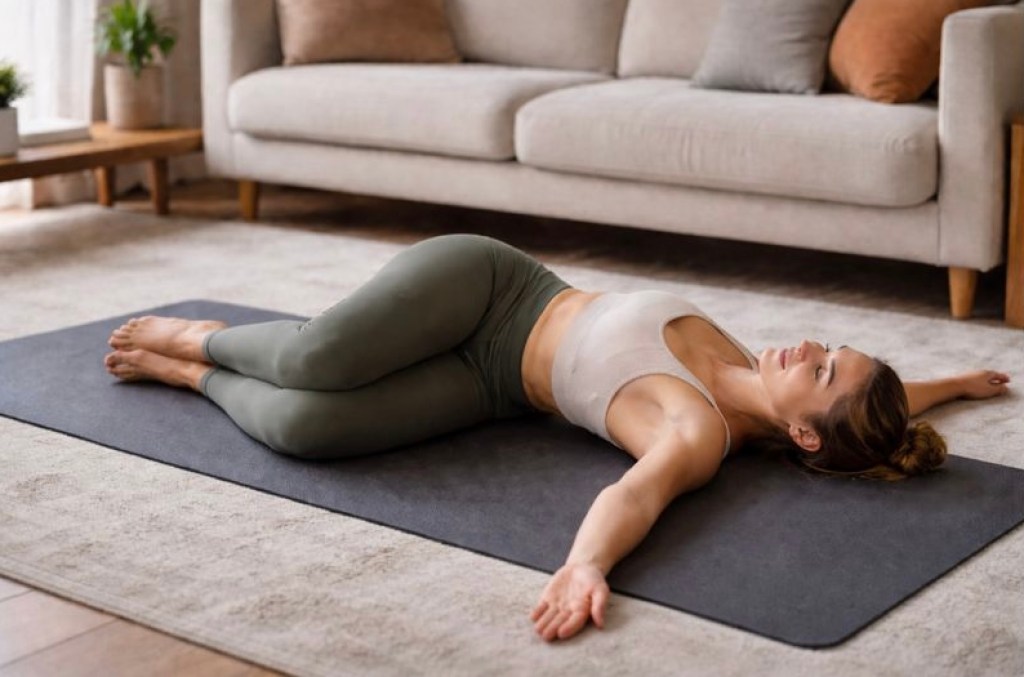
How to Do Supine Spinal Twist
Here’s how I typically cue my students to get in a Supine Spinal Twist.
- Lie on your back.
- Open your arms like the letter “T”. If you’re close to your neighbor, move your arms into a cactus shape, bending them so they’re flat at a 90-degree angle.
- Bend your legs so your feet are flat on the ground. Bring your legs together.
- With your legs bent at a 90-degree angle, lift them and release them to your left side. Turn your chin toward your right shoulder.
- Make sure both your shoulders are staying flat on the ground.
- Take several deep breaths. Return to center. Repeat on the other side, turning your knees toward the right and your chin toward the left.
Supine Spinal Twist Modification
If you’re especially flexible, you can go deeper into the Supine Spinal Twist by stacking your right leg on top and scooting your hips a few inches to the right, before releasing the knees to the left. This allows you to deepen your twist. Repeat the same variation on the other side to even out the twist.
Supine Spinal Twist Recommendation
To get the full benefit of a Supine Spinal Twist, it’s important to make sure both your shoulder blades are on the ground while you’re in your twist. If you find one shoulder is popping off the ground in order to help you achieve the twist, un-cross your legs, and stack them instead. Modify however your body needs to in the twist to ensure both your shoulder blades stay on the ground.
Supine Spinal Twist Reminder
With any yoga pose, it’s important to consult with your physician first before beginning a yoga practice. If you have spine or neck issues, talk with your doctor before attempting this pose.
As always, you should never feel pain in your yoga practice. If you do, move out of the pose you’re doing. Pause, rest and/or adjust, so that you enter the pose safely.
Supine Spinal Twist Benefits
While the main benefit of a Supine Spinal Twist is to hydrate the spinal discs, according to the “Yoga Toolbox,” Supine Spinal Twist supports health in nearly all of your body systems. These include:
- Digestive
- Eliminatory
- Lymphatic
- Muscular
- Nervous
- Reproductive
- Skeletal
- Urinary
A Supine Spinal Twist also helps you breathe more deeply by supporting rib cage expansion. Because this pose is so relaxing, it helps calm your nervous system and supports healing.
For these reasons, I love this pose so much! It’s the perfect way to help wind down after a challenging flow and makes you feel supported on the mat and on the earth.
Ways to Enhance Your Supine Spinal Twist in Your Practice
One of the best ways to deepen your practice, in my opinion, is to go inward by closing your eyes. Once you’re safely in a pose like Supine Spinal Twist, closing your eyes allows you to find a deeper sense of stillness. It supports the meditation in motion philosophy of yoga, where you can relax and let go a little bit more with every breath.
If you meditate at home or listen to a guided meditation or timed instrumental, you might try pairing a Supine Spinal Twist with your meditation. Make sure to switch sides halfway through so both sides of your body are supported.
Supine Spinal Twist is also a great pose to practice in bed. Make sure you have enough space and are in the middle of your bed. If you want to incorporate a few minutes of “bedtime yoga” before you go to sleep, this is a great pose to practice.
Happy twisting! Have another pose you’d like me to do a deep dive on in this yoga in Alexandria VA blog? Let me know.
About the author: Nicki Escudero is a journalist and RYT-200 yoga instructor certified by Yoga Alliance. She teaches group and private yoga classes in Alexandria, VA, and Washington, DC. Contact Nicki.


Leave a Reply