
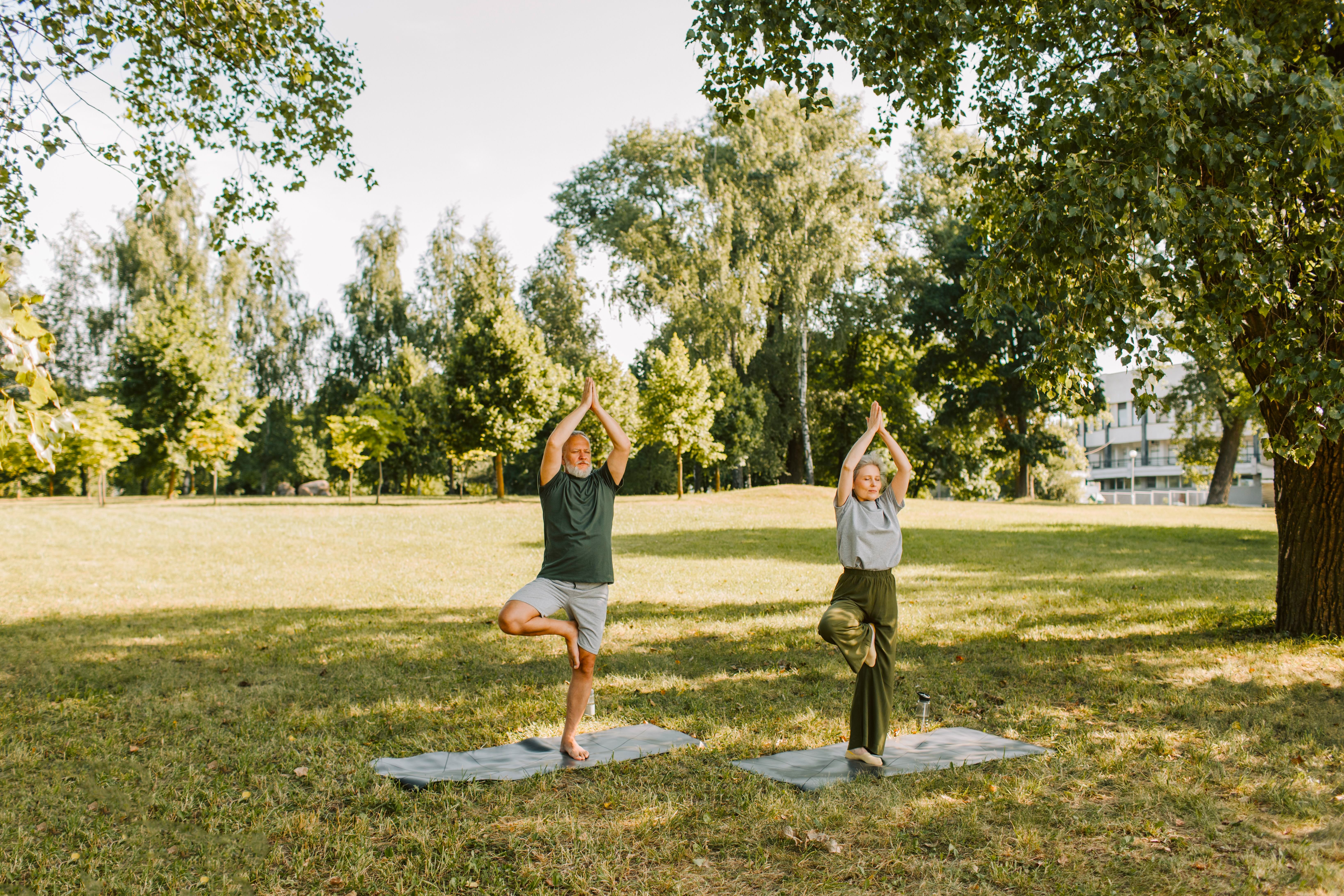
Whenever I’m teaching beginner yogis or students taking yoga for the first time, I typically like to select Tree Pose as a peak balancing yoga pose for the practice. I like Tree Pose for yogis of all levels for several reasons:
- It’s an accessible balancing yoga posture that most people, no matter what their yoga experience or physical fitness level is, can try.
- Tree Pose allows for a lot of self-expression, which makes it really enjoyable.
- You can make Tree Pose as challenging as you want it to be. Turn Tree Pose into an advanced posture by closing your eyes in yoga Tree Pose, for example.
I would say Tree Pose is also probably the most common balancing yoga pose I experience in other Alexandria, VA yoga classes I take. While this pose is extremely common in classes that including yoga balancing, it’s popular because it offers lots of physical and mental health benefits, especially as you progress and evolve your posture.
How to Do Tree Pose (Vrksasana) in Yoga

I typically save Tree Pose for the latter half of class, where we’re working on a peak pose before getting on the ground and stretching. Here’s how I typically cue students to get into Tree Pose.
- Start in Mountain Pose (Tadasana).
- Place your hands on your hips for help with balance. Root into one leg, your “trunk”. Choose your foot placement for the other leg. You can either place the ball of the foot on the ground and connect the heel with the other leg’s ankle, place the sole of the foot on the inner shin of the other leg, or reach for the foot and place it on the inside of the other leg’s thigh. Try to avoid placing the foot directly on the other leg’s knee.
- Once you have your foot placement, bring your hands together in prayer at heart center in Namaskar Mudra.
- You can stay there, or you can “grow” your tree. Raise your arms up and take whatever arm placement you want.
- Use your core to stay balanced. Hold the pose for several breaths.
- To come out of Tree Pose, bring your hands back to heart center if you’ve moved them. Slowly release the raised leg. Switch sides.
To make Tree Pose more challenging, look up, or close your eyes.
I always encourage my students to do whatever they want with their arms in Tree Pose, to express themselves. Sometimes, I wave my arm “branches” around, like I have a windy tree. Sometimes, there’s a bird in my tree. Sometimes, I bring my fingers into the Jnana Mudra. It’s also fun to try Eagle (Garudasana) arms in Tree Pose.
To make Tree Pose more challenging in your practice if you’re an experienced yogi, experiment with different arm placements. Even attempting to close your eyes for a second or two can be something satisfying to work on.
Tips for Tree Pose

Because Tree Pose is a balancing posture, it can be quite challenging for any level yogi. To advance your progress in Tree Pose, use these tips.
- Engage your core. That’s helpful for any balancing posture, including Tree Pose.
- Push the knee of the lifted leg to the side so that your body remains facing forward, not twisting to the side.
- Keep your heart and chest open.
- Root into the entire foot of the standing leg, rather than shifting the weight into one side or the ball of the foot.
- If the foot of the raised leg is connected to your inner thigh, push the inner thigh into the foot as much as you’re pushing the foot into the inner thigh.
Notice if your body is holding onto any tension. Try to relax to find the balance between effort and ease. Let your shoulders relax away from your ears. Use your breath to find a sense of stability, even if you’re moving your “branches”.
Benefits of Tree Pose
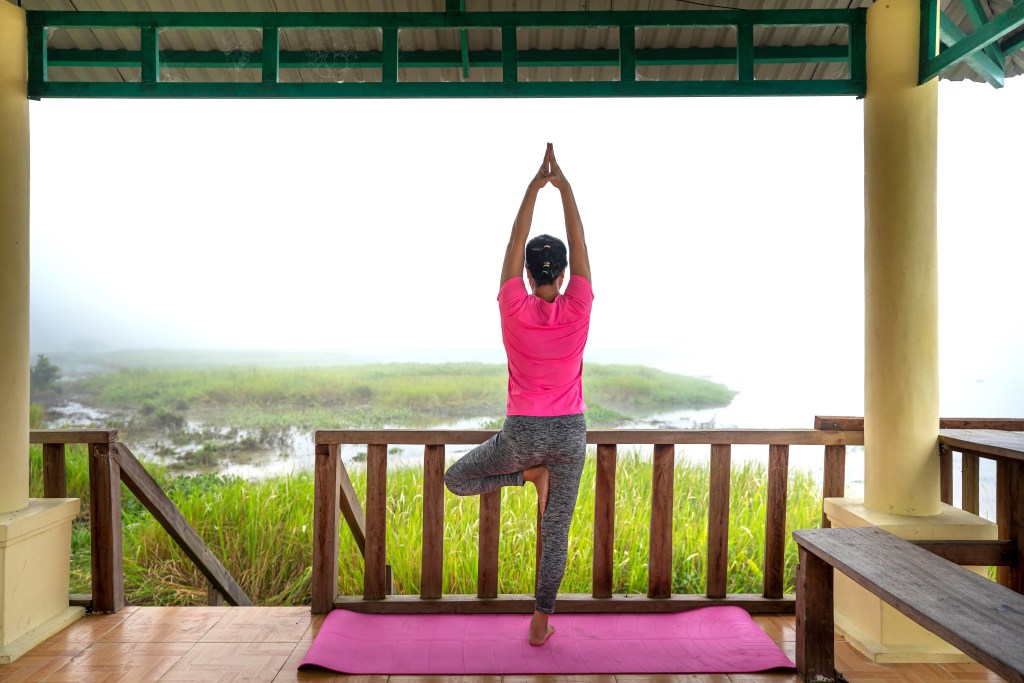
I really like how the “Yoga Toolbox” describes Tree Pose, as it encapsulates how all-encompassing this pose is for a yoga practice. According to “Yoga Toolbox”, various parts of Tree Pose symbolize the ethical precepts of yoga, the physical practice of yoga, the breath, meditation and more.
“Yoga Toolbox” states:
The tree is often used as an analogy for the Yoga journey…Tree Pose reminds us of the importance of integrating all the limbs of Yoga to unfold the full potential of the practice.
From a physical standpoint, Tree Pose balances the nervous, respiratory, reproductive, urinary, circulatory, endocrine, lymphatic, muscular and skeletal systems. Tree Pose benefits include:
- Stabilizes and strengthens the legs
- Improves core strength and balance
- Opens the hips
As you reach to the sky while staying grounded to the earth, the “Yoga Toolbox” also states Tree Pose “supports spiritual awakening”. I feel like doing Tree Pose makes me feel closer to nature. You could even do Tree Pose as an earthing practice among actual trees, to tap into feeling more as one with the natural world.
What Do You Think of Tree Pose?
Do you enjoy doing Tree Pose? How do you express yourself in Tree Pose? I’d love to hear your experience and tips – leave a comment.
Want to learn more about other yoga poses? Check out:
- Warrior II (Virabhadrasana II)
- Warrior I (Virabhadrasana I)
- Sukhasana (Easy Seat)
- Dancer Pose (Natarajasana)
- Mountain Pose (Tadasana)
- Pigeon Pose (Eka Pada Rajakapotasana)
- Savasana (Corpse Pose)
- Supine Spinal Twist (Supta Matsyendrasana)
- Child’s Pose (Balasana)
Is there another yoga pose you’d like me to explore next on this yoga in Alexandria blog? Message me.
About the author: Nicki Escudero is a journalist and RYT-200 yoga instructor certified by Yoga Alliance. She teaches group and private yoga classes in Alexandria, VA, and Washington, DC. Contact Nicki.


Leave a Reply